In computer science, polymorphism is the mechanism through which the same language object (e.g.: function, structure, class, method, operator, ...) can take different forms, either at compile-time or at runtime.
16.1.1Compile-time polymorphism
Compile-time polymorphism, also called parametric polymorphism, let us define one or more parameters for a single language object. Parametric objects are not concrete, they never appear as-is inside the final executable program. They are more like skeletons of code from which we may generate one or more versions, depending of what values we choose for the parameters. The parameters are placeholders for other language objects, typically types, structures or base values like integers or booleans, that can either be fixed by the developer or deduced from the context by the compiler.
In Figure 1, we define a parametric function add(T,T)
whose code is generic. When using it the compiler generates the needed
version. For instance if we use it on 32 bit integers, the compiler will
generate add<Int32>(). So among all the possible versions of add(T,T)
only the ones really used are generated. The same exact code is generated
multiple times by the compiler, but we have only written one function,
and we have only one to maintain.
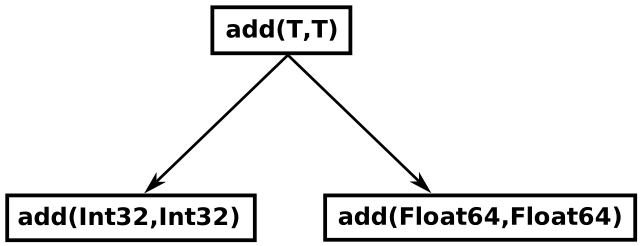
Figure 1:Parametric polymorphism
16.1.2Runtime polymorphism
Runtime polymorphism is a mechanism through which an object can be viewed in different ways during execution. Objects may be stored as their original type or as any view they provide. When required, we test if an object provides a certain view, and we transform it into this view.
Figure 2 shows a set of types representing animals that
we may use for instance in a game. The animals are Crocodile, Lizard,
Crow, Dolphin. We have link each animal to a group (Reptile, Bird,
Mammal). These groups are our views. At runtime we may transform each
of our animal into its group/view. The view Animal represents a
super-group for all animals. The view CanSwim, CanWalk, CanFly
represent the capabilities of our animals. Below we find a list of
functions that may be applied to our animals. For instance the
get_feather_type(Bird) may be called on any animal object that provides
the Bird view.
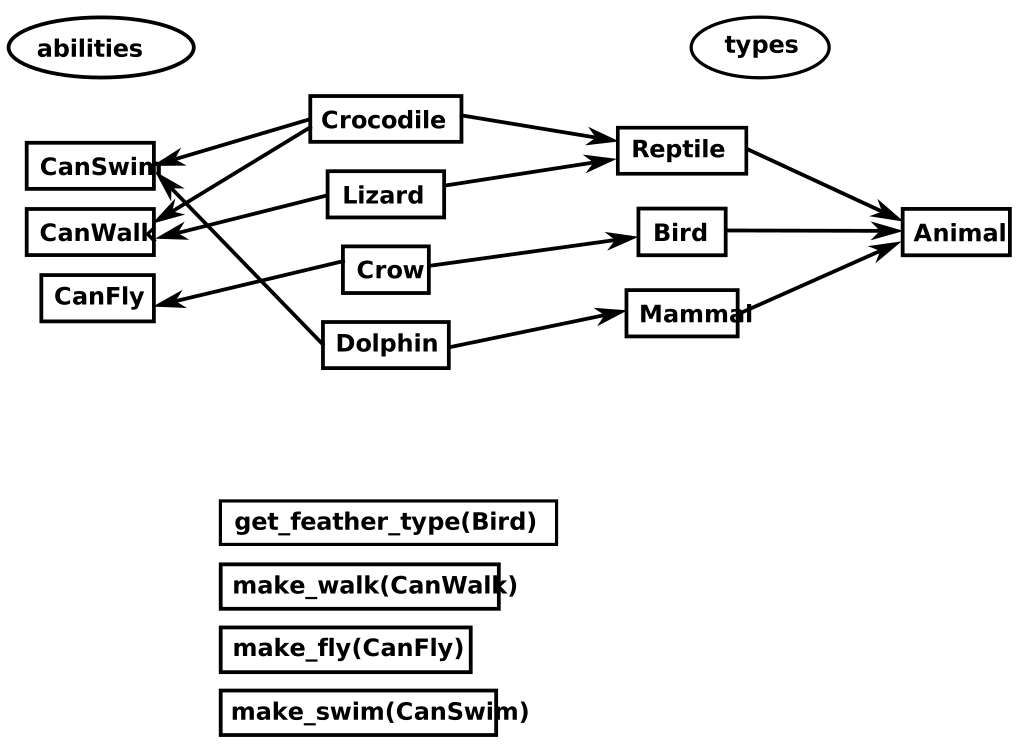
Figure 2:Runtime polymorphism