Among the world (see Figure 1), and particularly inside the research community, Rust is gaining popularity. Being a language, like C, primarily targeted to system programming, it offers great performance on which is added an excellent memory checking layer, and takes advantage of a high level of acceptability by the computer system teams when passing from research to production.
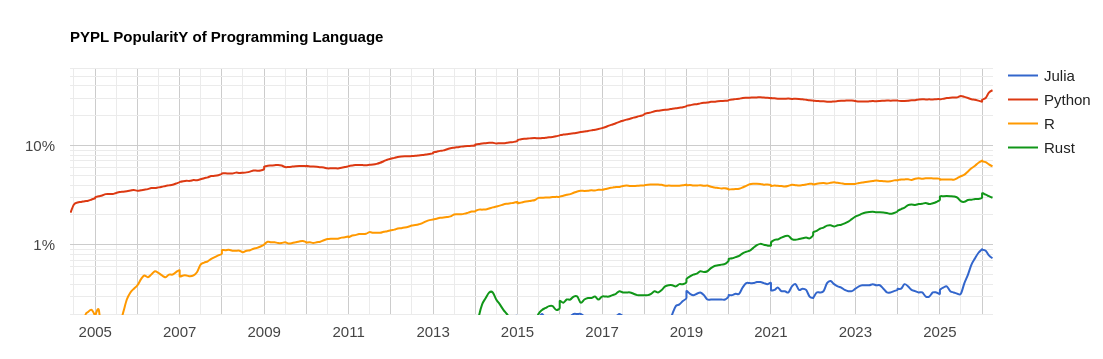
Figure 1:Comparison of popularity of Python, R, Julia and Rust (PYPL).
These are already some good reasons to choose Rust as a language, but not enough. Some generic questions (Perkel 2025) are more interesting:
How does Rust compare to the main languages used in the scientific community?
How is its ecosystem (community & packages) in general and in a specific research field?
Rust is already well identified as a possible replacement for Python (Perkel 2020) in the scientific community. Being already used by companies (Rust use cases), Rust is a well developed language for all aspects around computer systems. With its own strength, it compares well with other langagues (Rust vs Alternatives). The Rust community, while not as developed in size as main languages like R or Python, is quite active, and we have found it fairly easy to find an answer on common issues related to the language itself or its main packages. Numerous packages exist to solve standard programming problems, and many are created each day as seen in Figure 2.
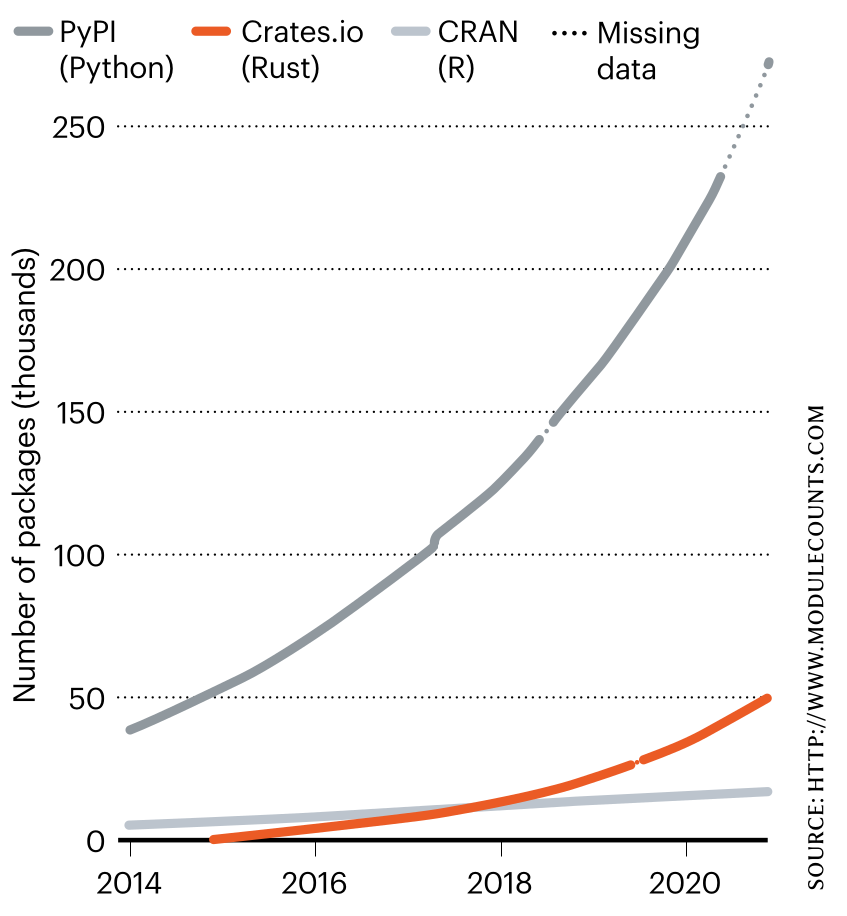
Figure 2:Number of packages over time for R, Python and Rust (Perkel 2020).
However it may be not as easy to develop a scientific application in a specific field. It would be a long task to look at available packages for all possible scientific fields, but we have looked at the packages available in the biology field for Rust and other languages (see Table 1). While Rust does not propose as many packages as R or Python, it is already well developed and should allow to develop applications in the field quite comfortably. In comparison, Julia, while an excellent language, designed by and for the research community, perfectly adapter for the biology field (Roesch et al. 2023), does not seem to attract as much attention as Rust.
Table 1:Rough number of biology related packages for Rust and some concurrent languages
Obtained by searching the text “bio biology” inside the official package repository.
Obtained from the Bioconductor site.
- Perkel, J. M. (2025). Which programming language should I use? A guide for early-career researchers. Nature, 640(8060), 1116–1117. 10.1038/d41586-025-01241-6
- Perkel, J. M. (2020). Why scientists are turning to Rust. Nature, 588(7836), 185–186. 10.1038/d41586-020-03382-2
- Roesch, E., Greener, J. G., MacLean, A. L., Nassar, H., Rackauckas, C., Holy, T. E., & Stumpf, M. P. H. (2023). Julia for biologists. Nature Methods, 20(5), 655–664. 10.1038/s41592-023-01832-z